 |
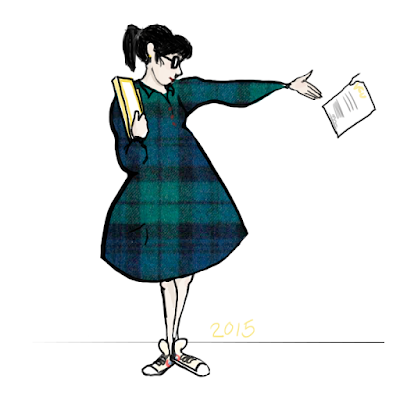
| 'Molly takes a waiver' with shades of Earl Oliver Hurst - 2015 |
Thursday, April 23, 2015

Monday, April 13, 2015

Friday, February 13, 2015
 |
| World Map of alternative medicine practices for a UNIV 291 Course Trailer. I loved that this map had annotations in Japanese, rather than in the usual Latin or Old English. |
Tuesday, February 10, 2015

Thursday, February 5, 2015
Head spaces
Adaptability has its limits, and I notice this most when I travel for business. As hated-on as it is, the standard office cubicle has it benefits for facilitating work flow: compact space with no potential for physical exploration; a consistent environment with regular neighbors; lower volume levels, neutral color palettes, a relative lack of embellishment. As a creative person, it's weird that I find myself longing for this space when traveling with work in mind. It brings up ideas of finding the "'right' head space" for facing and accomplishing tasks, how subtle changes in environment can impact the thinking/learning process.
After my first flight, I decided I loved flying -- a decision quickly reversed by my second trip, which involved 3 layovers and a total travel time of 14 hours. Yes, there's still that vague feeling of "adventure!" when you step into the terminal with your roll-y bag, but I don't think I'm the only one who feels a slight nausea and anxiety when they see a packed terminal. Last week, I traveled to Orlando. I had plenty of extra time to sit at my gate and work some, but trying to review my meeting itinerary and respond to emails was hopeless. The combination of self-consciousness, feelings of ill-preparedness, distracting co-travelers, and ansty-ness to catch the flight culminated in me seriously being unable to focus... but not only that. I found myself feeling more and more impatient-- super unusual for an early riser like me. Why did I feel so unlike myself? Who had the power here: my environment or me?
I was traveling for Calibration: a big, weekend-long meeting my sub-committee takes every year to hash out a bunch of decisions and pitch new ideas for current and future conferences (some background: it's a sub-committee for the Student Volunteer Program for a little conference called SIGGRAPH.).
Three days of collaboration in the strange-smelling house let us work our brains to the max in a total "control" environment. In the same way the hectic airport brought out the negativity in me, being in the blank slate AirBnB allowed some of my inborn personality traits emerge. Instead of feeling the need to behave a certain way (a pressure you typically can't escape in any situation but solitude or family time), I could let go of my self-imposed "shoulds" and play to my individual strengths. Without any external pressure influencing our behavior, we revealed ourselves to be a pretty well-balanced team of talkers and listeners, passives and aggressives).
The idea of environment dictating personality plays into another I had an idea for another blog posts about hallowed halls of learning and how feelings of reverence for historic sites/figures can affect the way students approach work. If all modern classrooms were actually located at the site of Aristotle's Lyceum, would lessons feel more meaningful? If my Calibration meeting had taken place in Boulder, Colorado at the site of the very first SIGGRAPH conference, would we behave any differently? It's strange to consider how many factors can potentially shift the way you think.
The experience was very revealing and brought to light another important aspect of collaboration, too:
bonding. Connected learning via the internet is a big thing at my work
(and that's a big understatement), and though I know it's great from an
academic point of view, there's something to be said about learning
from, connecting, and engaging in-person with people you trust and
enjoy spending time with. The fact that we came together being
completely ourselves amplified the learning experience. One of my
teammates said something really significant: we come to Calibration with
the objective of accomplishing a few specific tasks, but that's not
what it's about. It's about accomplishing objectives while learning about one another, feeling out
the group dynamic, and gauging what efforts are needed to become the most
successful, happy team possible. This is an idea that I'll certainly carry with me into my own work, especially as it connects to collaboration and connected learning.
The takeaway from all this is a potpourri of "be yourself," "be aware of yourself," "be aware of your surroundings," and "don't underestimate the power of friendship." Oh, and "don't go to Harry Potter World thinking you'll accomplish anything." You think you'll sit down and discuss the last of your meeting agenda, but you won't. Too many dragons.
E
0
 |
| Unforgettable moments at Gate B71 |
After my first flight, I decided I loved flying -- a decision quickly reversed by my second trip, which involved 3 layovers and a total travel time of 14 hours. Yes, there's still that vague feeling of "adventure!" when you step into the terminal with your roll-y bag, but I don't think I'm the only one who feels a slight nausea and anxiety when they see a packed terminal. Last week, I traveled to Orlando. I had plenty of extra time to sit at my gate and work some, but trying to review my meeting itinerary and respond to emails was hopeless. The combination of self-consciousness, feelings of ill-preparedness, distracting co-travelers, and ansty-ness to catch the flight culminated in me seriously being unable to focus... but not only that. I found myself feeling more and more impatient-- super unusual for an early riser like me. Why did I feel so unlike myself? Who had the power here: my environment or me?
I was traveling for Calibration: a big, weekend-long meeting my sub-committee takes every year to hash out a bunch of decisions and pitch new ideas for current and future conferences (some background: it's a sub-committee for the Student Volunteer Program for a little conference called SIGGRAPH.).
cal·i·brate
ˈkaləˌbrāt/
verb
gerund or present participle: calibrating
mark (a gauge or instrument) with a standard scale of readings.
- correlate the readings of (an instrument) with those of a standard in order to check the instrument's accuracy.
- adjust (experimental results) to take external factors into account or to allow comparison with other data.
Three days of collaboration in the strange-smelling house let us work our brains to the max in a total "control" environment. In the same way the hectic airport brought out the negativity in me, being in the blank slate AirBnB allowed some of my inborn personality traits emerge. Instead of feeling the need to behave a certain way (a pressure you typically can't escape in any situation but solitude or family time), I could let go of my self-imposed "shoulds" and play to my individual strengths. Without any external pressure influencing our behavior, we revealed ourselves to be a pretty well-balanced team of talkers and listeners, passives and aggressives).
The idea of environment dictating personality plays into another I had an idea for another blog posts about hallowed halls of learning and how feelings of reverence for historic sites/figures can affect the way students approach work. If all modern classrooms were actually located at the site of Aristotle's Lyceum, would lessons feel more meaningful? If my Calibration meeting had taken place in Boulder, Colorado at the site of the very first SIGGRAPH conference, would we behave any differently? It's strange to consider how many factors can potentially shift the way you think.


 | ||||||||||||||||||||||||||||||||||
| My 5 awesome teammates + a gremlin at Harry Potter World on our last day. |
 |
| At the airport, I learned that Psychology Today is actually not that awesome of a resource for finding academic articles about psychology; BUT it does make you look smarter than everyone else in the terminal as you enjoy your $17 muffin and coffee. |
The takeaway from all this is a potpourri of "be yourself," "be aware of yourself," "be aware of your surroundings," and "don't underestimate the power of friendship." Oh, and "don't go to Harry Potter World thinking you'll accomplish anything." You think you'll sit down and discuss the last of your meeting agenda, but you won't. Too many dragons.
E
Tuesday, January 27, 2015
Distractions

figure 1-a. doodling a Charlie with my notes helps me remember important ideas for structure and flow during the editing process.
When I was a kid (and teenager, and college student), I always drew pictures in the margins of my spiral-bound notebooks, reading handouts, and back pages of textbooks. Teachers would kindly ask me to stop drawing during their presentations, and I'd cease for as long as I could... which usually wasn't long. When I went to study for whatever test was coming up, I'd kick myself for forgetting to take actual notes; Instead of information there'd just be goofy faces staring back at me.
Despite my inability to write anything of value in notebooks, I'd still end up with high scores on tests. Studies have shown that doodlers actually -aren't- goldfish people (a silly assumption anyway; the average human attention span is 8 seconds -- which is actually 1 second less than the average goldfish), but we still have a collective tendency to regard seemingly distracted folks - doodlers, fidgeters, etc. -- as bored, daydreaming, or plain uninterested.
In truth, it's a pretty understandable reaction; when we ask for the attention of others in a social setting, work setting, or otherwise... anything less than eye contact and stillness can be interpreted as "I don't care enough about what you have to say to refrain from doing _____." However (all comments about ego and self-importance aside), I think these kneejerk interpretations have created a very strange expectation of student behavior and a poisonous idea that's becoming increasingly common in some educational settings: that a lack of attention points to a lack of intelligence.
"Why aren't you paying attention?
You don't want to be held back, do you?
Don't you care about getting into high school?"
These are questions that have been posed to my elementary school-aged brothers, who have also been (in my opinion, overly eagerly) diagnosed as attention-deficient and subsequently medicated... and I know they aren't the only ones. This immensely concerning to me not only as a sister, but also as someone who's worked with public school elementary teachers firsthand... and witnessed a rather desultory approach to curriculum and very real reluctance to cover any material not required on standardized tests - namely, the Virginia SOL.
It's not a matter of lack of caring or lack of investment -- it's a matter of engagement, and further, being permitted to engage with subjects in a way that makes the most of your natural learning styles. For me, it's a mesh of visual and tactile; information thrown at me synthesizes when my hand makes lines and shapes. Synapses fire and facts are committed to memory when I tweak the details on a shadow. The brain works in the same way for many with a million other activities -- exercise, listening to music, raking leaves; My dad's best thinking sessions come while making mailboxes. However, these predominantly kinesthetic learning styles can't be supported in today's rigid classroom --and they get shut down.
This was supposed to be a post about fun doodles but it turned sort of heavy. Oof. All this goes to reinforce the old adage: don't judge a book (especially a doodler's book) by it's cover. But beyond that, don't be so quick to assume someone else is going to get the same story by reading the book. Watch them illustrate the book, make annotations at the bottom of the page, adapt the book into a play, or song, or even turn the pages into original origami sculptures. A good teacher accepts the fact that the brain works in mysterious ways; a great teacher (and learner) embraces it.
E
E
Monday, January 26, 2015
Lather
I think better in pictures than in words, so before you get any ideas, I'm setting the record straight: Most of what comes out of my mouth (keyboard?) is as clumsy and uncoordinated as a Junior Varsity running back. Don't get excited.
This is a space where I'll be posting concept drawings, WIPs, processes and breakdowns of different projects from my place of work (and maybe some of my own stories, too). Most of them will be centered around awfully cool topics like new digital media, modern pedagogy, and the changing winds in University-level education. Admittedly, I'm not an expert on instruction; my cumulative experience teaching comes to a whopping 3 days. But, I've already bought a copy of Educational Psychology to test the waters and lather my brain in the topic.
To sum it up: This is me, and I'm stoked to be here. Let the learning begin!

(power pose)
footnote: I doodle a lot. Especially self-portraits and sketches of the people I see day to day. If you interact with me regularly in any way, shape or form... you've been warned!
- E
Subscribe to:
Posts (Atom)